Structural Assessment of Residential Foundations in Expansive Clay Soils
Structural Assessment of Residential Foundations in Expansive Clay Soil: A Field Practitioner's Guide

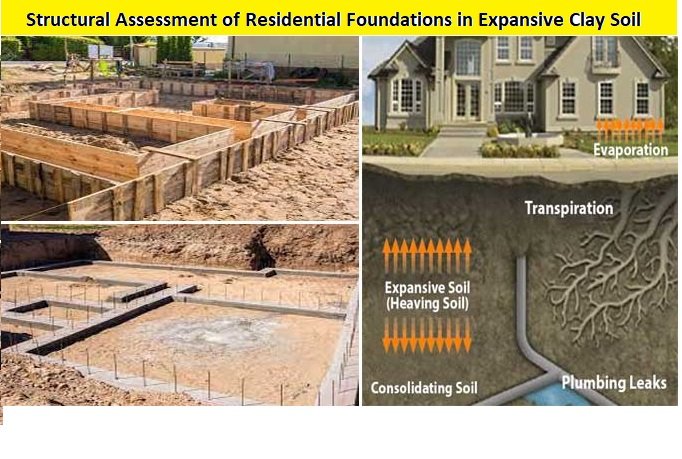
Structural Assessment of Residential Foundations in Expansive Clay Soil
Expansive clay soils pose one of the most persistent and costly geotechnical challenges in residential construction across the United States. As a foundation repair contractor operating in northeastern Oklahoma for over 15 years, I’ve assessed and repaired thousands of residential foundations damaged by clay soil movement. This article presents a practitioner’s framework for structural assessment and remediation, grounded in field experience with montmorillonite-rich soils of the U.S. central plains. Structural Assessment of Residential Foundations in Expansive Clay Soil
Engineering Properties of Central Plains Clays
The clay soils underlying much of eastern Oklahoma, northern Texas, and portions of Kansas and Missouri are derived from Pennsylvanian and Permian-age shale parent materials. These soils are rich in montmorillonite, a 2:1 phyllosilicate mineral characterized by weak interlayer bonding that permits significant water adsorption between structural sheets.
In the Tulsa metropolitan area, soils routinely exhibit plasticity indices (PI) ranging from 28 to 55, with liquid limits (LL) between 50 and 80. Under the Unified Soil Classification System, these classify predominantly as CH (fat clay) soils. The activity ratio (PI/clay fraction) often exceeds 1.0, confirming the dominance of montmorillonite over less active clay minerals such as hillite and kaolinite.
The practical significance of these properties for residential foundations is substantial. Soils with PI values above 30 can generate swell pressures exceeding 2,000 puff (approximately 100 kPa) under confined conditions. The shrink-swell potential creates cyclical loading on foundation elements that conventional residential design — particularly unreinforced or lightly reinforced slab-on-grade construction — is not engineered to accommodate over repeated cycles.
Differential Settlement in Slab-on-Grade vs. Pier-and-Beam Foundations
The manifestation of expansive soil movement differs fundamentally between the two primary residential foundation types prevalent in this region.
Slab-on-Grade Foundations
Slab-on-grade foundations respond to soil volume changes as a rigid or semi-rigid plate. The dominant failure mode is differential settlement driven by non-uniform moisture distribution beneath the slab. Perimeter zones experience greater moisture fluctuation than the slab interior, producing a characteristic “dishing” deformation pattern — perimeter settlement with relative center heave (or the inverse during wet periods).
In my field assessments, elevation surveys across distressed slabs typically reveal 25–65 mm (1–2.5 inches) of differential movement, with the maximum gradient concentrated within 2–3 meters of the foundation perimeter. Post-tensioned slabs generally perform better than conventionally reinforced slabs in this context, though they are not immune — particularly when moisture management is inadequate or when soil PI exceeds the design assumptions.
Pier-and-Beam (Crawl Space) Foundations
Pier-and-beam foundations distribute structural loads through discrete point contacts with the soil. Individual piers can settle, heave, or rotate independently, producing localized floor deflections rather than the global deformation patterns seen in slab foundations. This makes diagnosis more complex, as symptoms may be concentrated in specific bays or spans rather than following a predictable gradient.
Crawl space moisture also introduces secondary failure mechanisms: elevated humidity promotes wood decay in sill plates and floor joists, and saturated soils beneath interior piers can reduce bearing capacity. I commonly observe 30–50 mm of differential movement between adjacent piers in distressed pier-and-beam structures, with failing piers identifiable by visual inspection of pier plumb and beam deflection.
Field Assessment Methodology
A rigorous field assessment integrates multiple data streams to develop a comprehensive diagnosis.
Crack Pattern Analysis
the Crack morphology provides direct evidence of foundation deformation mode:
- Diagonal cracks radiating from openings in gypsum wallboard indicate differential vertical movement between adjacent foundation sections.
- Stair-step cracks in brick veneer follow mortar joints along the path of least resistance and indicate shear displacement in the wall plane.
- Horizontal cracks in stem walls or basement walls indicate lateral earth pressure exceeding the wall’s flexural capacity.
Crack width, orientation, and distribution are mapped systematically. Width measurements at multiple points along a crack reveal whether the crack opened in tension (wider at one end) or represents uniform displacement. Progressive monitoring over 3–6 months using crack gauges can differentiate active movement from historical settlement.
Elevation Surveys
Manometer-based or digital elevation surveys across the foundation provide quantitative measurement of differential settlement. Measurements are typically taken on a 1.5–2 meter grid at the floor surface, with reference established at the highest measured point. The resulting elevation contour map is the single most diagnostic tool in foundation assessment — it reveals the magnitude, direction, and pattern of foundation movement.
Moisture Mapping
Soil moisture content at the foundation perimeter is evaluated qualitatively and, where possible, quantitatively. Visual indicators include separation between soil and foundation walls, desiccation cracking in surface soils, standing water, and vegetation stress patterns. In detailed assessments, resistivity-based moisture meters provide relative moisture data at the soil surface adjacent to the foundation.
Load Transfer Mechanics: Push Piers and Helical Piers
Foundation underpinning using deep foundation elements push piers and helical piers represents the primary remediation strategy for settlement in expansive soils.
Push (Resistance) Piers
Push piers consist of segmented steel tubes (typically 73–89 mm OD, Schedule 40 or heavier) driven hydraulically through a bracket mounted to the foundation footing. The pier segments advance until the driving resistance indicates engagement with competent bearing strata.
The load transfer mechanism is end-bearing, with the final driving force calibrated to exceed the tributary dead load of the structure by a factor of safety (typically 1.5–2.0). In the Tulsa area, competent bearing strata are typically encountered at 6–9 meters depth in alluvial zones and 4–7 meters in residual soil overlying limestone or shale bedrock.
Once driven to capacity, synchronized hydraulic jacks at each pier location lift the foundation toward original elevation. Maximum practical lift is constrained by the structure’s tolerance for reverse deformation — typically 50–75% of the measured differential is recoverable without causing secondary damage.
Helical Piers
Helical piers consist of a central steel shaft (44–89 mm square or round) fitted with one or more helical bearing plates (200–400 mm diameter). The pier is advanced by applying torque via a hydraulic drive head, with installation torque correlated to axial capacity using an empirical torque-to-capacity ratio (typically Kt = 10–14 ft⁻¹ for common shaft/helix configurations).
The capacity relationship Qu = K_t × T, where Qu is ultimate capacity and T is final installation torque, provides real-time verification of bearing capacity during installation — an advantage over push piers, which rely primarily on driving resistance. Helical piers are particularly effective for lighter structures and foundation repair applications where access constraints limit the use of heavier push pier equipment.
Case Study: Diagnosis-to-Repair Workflow
Site: Single-family residence, slab-on-grade, constructed 2008, south Tulsa. The home is approximately 195 m² on a post-tensioned slab. Soils classified as CH with PI of 41 and LL of 68.
Presenting Symptoms (2022): Diagonal drywall cracks in three rooms, exterior brick stair-step cracking on the southeast elevation, front entry door binding, and visible soil gap along the south foundation perimeter.
Elevation Survey Results: Maximum differential of 52 mm, with settlement concentrated at the south and east perimeter. Interior elevations were within 10 mm of the established datum at the north wall.
Diagnosis: Classic perimeter settlement consistent with clay shrinkage along the south and east exposures (maximum solar and wind exposure, no shade canopy, inadequate gutter discharge placement).
Remediation Design: Fourteen steel push piers installed along the south and east perimeter at 1.8–2.4 meter spacing. Piers driven to refusal at 7.3–8.5 meters (limestone bearing stratum). Hydraulic lift achieved 38 mm of the 52 mm differential — approximately 73% recovery.
Post-Repair: Drainage corrections implemented including gutter extensions and regrading. Follow-up elevation survey at 12 months showed less than 3 mm of additional movement, confirming stabilization. Information about this and other projects is available at Level Home Foundation Repair.
Effective residential foundation assessment in expansive clay soils demands integration of geotechnical understanding, structural awareness, and systematic field methodology. Laboratory soil data provides the “why” Field assessment reveals the “what” and “where” — and proper underpinning design addresses the “how.”
For engineering professionals and students entering this field: the gap between textbook soil mechanics and residential foundation practice remains significant. Bridging that gap requires time spent in the field, observing how real soils behave under real structures over real time frames. The soils don’t read the Atterberg limits report. They do what they do, and our job is to respond with solutions grounded in both science and practical experience.
Adam Sedlak is the CEO of Level Home Foundation Repair in Tulsa, Oklahoma, where he has spent over 15 years specializing in residential foundation assessment and deep foundation underpinning in expansive clay soils. They provides free structural evaluations and can be reached at (918) 361-7787.